
United Kingdom


The ca. 640,000 units built, constituted a quarter of the total U.S. non-combat motor vehicle production in the war,[6] and almost two thirds of the ca. 988,000 light vehicle class, together with the Dodge WC series, outnumbering those by almost two to one."In many respects, the jeep became the iconic vehicle of World War II, with an almost mythological reputation.." — (Hyde, 2013)[4], having proven itself exceptionally capable, tough, durable and versatile. Not only did it literally become the workhorse of the American military, as it replaced the use of horses and other draft animals (still abundant in World War I), in every role, from cavalry units to supply trains. But also, improvised field-modifications made the jeep capable of just about any function GI's could think of.
Variants
- Jeep Open topped
- Jeep covered
- Airborne Jeep
- Airborne Jeep - Recon
- SAS/LRDG Jeep - desert
- SAS Jeep - European Theatre
- SAS Jeep - European Theatre armoured
- Jeep with .50cal MG
- Jeep with .30cal MG

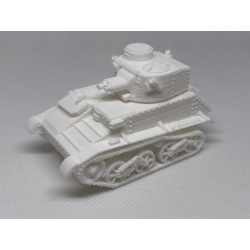
The Tank, Light, Mk VI was the sixth in the line of light tanks built by Vickers-Armstrongs for the British Army during the interwar period. The company had achieved a degree of standardization with their previous five models, and the Mark VI was identical in all but a few respects. The turret, which had been expanded in the Mk V to allow a three-man crew to operate the tank, was further expanded to give room in its rear for a wireless set.[6] The weight of the tank was increased to 10,800 pounds (4,900 kg), which although heavier than previous models actually improved its handling characteristics, and an 88 horsepower (66 kW) engine was added to the model to increase its maximum speed to 35 miles per hour (56 km/h).
It had the Horstmann coil-spring suspension system, which was found to be durable and reliable, although the fact that the tank was short in relation to its width and that it pitched violently on rough ground made accurate gunnery whilst moving exceptionally difficult.[5] The Mk VI possessed a crew of three consisting of a driver, gunner and commander, who also doubled as the radio operator, between 4 millimetres (0.16 in) and 14 millimetres (0.55 in) of armour, which could resist rifle and machine gun bullets, and its armament consisted of one water-cooled .303 inch and one .50 inch Vickers machine gun.

Though the British expected to have their own new tank models developed soon, the previously rejected idea of mounting the 17-pounder in the existing Sherman was eventually accepted, despite initial government resistance. This proved fortunate, as both the Cruiser Mk VIII Challenger and Cruiser Mk VIII Cromwell tank designs experienced difficulties and delays.
After the difficult problem of getting such a large gun to fit in the Sherman's turret was solved, the Firefly was put into production in early 1944, in time to equip Field Marshal Montgomery's 21st Army Group for the Normandy landings. It soon became highly valued, as its gun could almost always penetrate the armour of the Panther and Tiger tanks it faced in Normandy. In recognition of this, German tank and anti-tank gun crews were instructed to attack Fireflies first.[citation needed] Because the Firefly had a visibly longer barrel, crews tried to camouflage it so the tank would look like a normal 75 mm-gun Sherman from a distance. Between 2,100 and 2,200 were manufactured before production wound down in 1945.

In the British naming system, the major variants were identified by Mark numbers, the M4 being "Sherman I", the M4A1 "Sherman II" and so on. Letters after the mark number denoted modifications to the base model: "A" for the 76 mm L/55 gun instead of the 75mm, "B" for the 105 mm M4 L/22.5 howitzer, "C" for the (British) QF 17 pounder (76.2 mm) gun, and "Y" for the later wider-tracked Horizontal Volute Spring Suspension (HVSS) type suspension. Gun and suspension letters were used in combination, e.g. Sherman IBY. However, no production 75mm Shermans were built with HVSS and no HVSS 17pdr conversions (CY) therefore existed. HVSS Shermans were only fitted with 76mm M1 guns or 105mm M4 howitzers, AY and BY respectively in British service.
- Sherman I - M4 with 75 mm M3 L/40 gun and Continental R975 9-cylinder radial petrol engine
- Sherman Hybrid I - Sherman I with composite hull (cast front, welded rear)
- Sherman IB - Sherman I with 105 mm M4 L/22.5 howitzer
- Sherman IBY - Sherman IB with HVSS
- Sherman II - M4A1 with 75 mm M3 L/40 gun and Continental R975 radial petrol engine
- Sherman IIA - M4A1(76)W, Sherman II with 76 mm M1 L/55 gun
- Sherman IIAY - M4A1(76)W HVSS, Sherman IIA with HVSS
- Sherman III - M4A2 with 75 mm M3 L/40 gun and GM6046 twin 6-cylinder diesel engine
- Sherman IIIA - M4A2(76)W, Sherman III with 76 mm M1A2 L/55 gun (unlikely to have been used by UK troops)
- Sherman IIIAY - M4A2(76)W HVSS, Sherman IIIA with HVSS (not used operationally by UK troops)
- Sherman IV - M4A3 with 75 mm M3 L/40 gun (no Sherman IVs used operationally) and Ford GAA V8 petrol engine
- Sherman IVA - M4A3(76)W, Sherman IV with 76 mm M1A2 L/55 gun
- Sherman IVB - M4A3(105), Sherman IV with 105 mm M4 L/22.5 howitzer
- Sherman IVBY - M4A3(105) HVSS, Sherman IVB with HVSS
- Sherman V - M4A4 with 75 mm M3 L/40 gun and Chrysler A57 multibank 30-cylinder "cloverleaf" petrol engine in a longer rear hull with more widely spaced bogies
- Sherman VI - M4A5 (paper designation for Canadian production)
- Sherman VII - M4A6 with 75 mm M3 L/40 gun, composite cast/welded hull and Ordnance RD-1820 9-cylinder radial diesel engine. Only 75 M4A6 were built and none are believed to have reached the UK
- Sherman II ARV III - M32B1 TRV (M4A1 Sherman II chassis) recovery vehicle
- Sherman V ARV III - M32B4 TRV (M4A4 Sherman V chassis) recovery vehicle. Extremely rare, almost mythical, vehicle. Production records are sketchy and British use is uncertain, but a photo does exist of an M32B4 in post-war Greek service


The Tortoise heavy assault tank (A39) was a British heavy assault gun design developed during the Second World War, but never put into mass production. It was developed for the task of clearing heavily fortified areas such as the Siegfried Line and as a result favoured armour protection over mobility.
Although heavy, at 78 tons, and not readily transported, it was considered reliable and a good gun platform.[1]
Only a few prototypes of the Tortoise had been produced by the end of the war.


The Humber Armoured Car was one of the most widely produced British armoured cars of the Second World War. It supplemented the Humber Light Reconnaissance Car and remained in service until the end of the war.
Made by the Rootes Group, the Humber was essentially a combination of the Karrier KT 4 artillery tractor chassis and the armoured body of the Guy Armoured Car. The KT4 was already in production for the Indian Army, and Guy were having problems with the production levels required. The Karrier name was dropped to avoid confusion.[3]
The first order for 500 was placed in 1940. The first Humbers were more or less identical to the Guy down to the faults in the armour, but this was later rectified. Production started in 1941.
The Mark III improved upon the Mark II by providing a three-man turret. Mark III production ended in 1942 after 1,650 had been built. With a possible replacement, the 2-pounder armed Coventry armoured car, on its way, the Mark IV was designed. This put the US 37 mm gun in the turret but at the cost of one crewman. The Coventry was not ordered as a replacement and so production of Mark IV continued, for a total of 2,000, despite its flaws.

The Daimler Armoured Car was a successful British armoured car design of the Second World War that continued in service into the 1950s. It was designed for armed reconnaissance and liaison purposes. During the postwar era, it doubled as an internal security vehicle in a number of countries.
Former British Daimler armoured cars were exported to various Commonwealth of Nations member states throughout the 1950s and 1960s. In 2012, some were still being operated by the Qatari Army.


The Tank, Infantry, Mk IV (A22) Churchill was a British heavy infantry tank used in the Second World War, best known for its heavy armour, large longitudinal chassis with all-around tracks with multiple bogies, its ability to climb steep slopes, and its use as the basis of many specialist vehicles. It was one of the heaviest Allied tanks of the war.
The origins of the design lay in the expectation that war in Europe might be fought under similar conditions to those of the First World War and emphasised the ability to cross difficult ground. The Churchill was rushed into production to build up British defences against a possible German invasion. The first vehicles had flaws that had to be overcome before the Churchill was accepted for wide use. After several marks had been built, a better-armoured version, the Mark VII, entered service. The improved versions performed well in the later stages of the war.[2]
The Churchill was used by British and other Commonwealth forces during the North African, Italian and North-West Europe campaigns. In addition, 344 Churchills were exported to the Soviet Union during the Second World War and more than 250 saw active service on the Eastern Front.

Churchill AVRE was a Churchill III or IV armed with a 290 mm petard spigot mortar, officially designated; Mortar, Recoiling, Spigot, 290mm, Mk I or II.[2] The mount replaced the 6 pounder gun in welded turrets on the Mark III and cast turrets on the Mark IV, otherwise the vehicles are identical. The 6 pounder gun mounting was modified, and retained the 6 pounder sights although "flying dustbin" effective range was only around 80 yards of 230 maximum.
Crew was increased to six to accommodate a demolition NCO in addition to driver, commander, gunner, wireless operator, and co-driver/machine gunner.
Internal ammunition stowage and the co-driver / hull gunner's seat was removed to provide compartments for demolition charges. This housed stores of the "General Wade" 26 lb explosive charge, and "Beehive" charges of up to 75 lbs of explosive. Both types of charge had to be set manually, but could be detonated from the relative safety of the AVRE interior. In the remaining space, compartments in the sponsons were created fore and aft of the side hatches for "flying dustbin" ammunition.


The Tank, Heavy, TOG II* was a prototype British tank design produced in the early part of the Second World War in case the battlefields of northern France devolved into a morass of mud, trenches and craters as had happened during the First World War. When this did not happen the tank was deemed unnecessary and the project terminated. A development of the TOG I design, only a single prototype was built before the project was dropped.
The second design to come out of the Special Vehicle Development Committee (nicknamed "The Old Gang" as it was made up of people who had worked on the original British tanks of the First World War) the TOG 2 was similar to the TOG 1 and kept many of its features. Instead of the track path arrangement of the TOG 1 which - like that of the First World War British tanks - ran up over the top of the hull and back down, the track path was lower on the return run and the doors were above the tracks. Ordered in 1940, built by Foster's of Lincoln, the prototype ran for the first time in March 1941.
The design included a 6-pounder gun and side sponsons. Initially fitted with a mockup turret with a dummy gun, in 1942 it was given a turret that was under development for the Cruiser Mk VIII Challenger tank design with the QF 17-pounder (76.2 mm) gun. The turret "in modified form" was used on the Challenger. The planned sponsons were never fitted.
Although equipped with the same electro-mechanical drive as originally fitted to the TOG 1, the TOG 2 used twin generators and no problems were reported. It was modified to include, among other things, a change from the unsprung tracks to a torsion bar suspension and went through successful trials in May 1943. No further development occurred, although a revised version, the TOG 2 (R) was proposed. The 'R' would have been 6 ft (1.8 m) shorter, used torsion bar suspension and had no sponsons.
The single TOG 2 prototype can be seen at The Tank Museum
