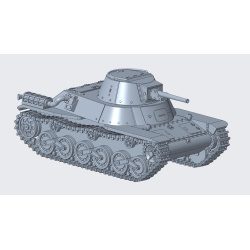
Tanks were an important weapons system in World War II. Even though tanks in the inter-war years were the subject of widespread research, production was limited to relatively small numbers in a few countries. However, during World War II most armies employed tanks, and production levels reached thousands each month. Tank usage, doctrine and production varied widely among the combatant nations. By war's end, a consensus was emerging regarding tank doctrine and design.
Type 1 Ho-Ki armored personnel carrier
The Type 1 Ho-Ki was produced as a result of a request from the army for a heavy armored artillery tractor, which could also serve as a personnel transport in order to increase the motorization and cross-country capabilities of the land forces. Several prototypes were built. The first one built on a Type 92 tankette chassis was known as the Type TC. The second prototype built was known as the Type TE. Development of both tracked and half-track APCs intensified in 1941, with two production versions confusingly designated “Type 1" (see the Type 1 Ho-Ha half-track).
T-70 Light Tank
The T-70 is a light tank used by the Red Army during World War II, replacing both the T-60 scout tank for reconnaissance and the T-50 light infantry tank for infantry support. The T-80 light tank was a more advanced version of the T-70 with a two-man turret—it was produced only in very small numbers when light tank production was abandoned. The T-90 self-propelled anti-aircraft gun was a prototype vehicle with twin machine guns, based on the T-70 chassis.
Type 91 So-Mo Armoured Car
The Type 91 So-Mo (Japanese: Kyū isshiki kōki ken'in-sha) was a bimodal road-rail armored car adopted by the Imperial Japanese Army in 91. It was characterized by the possibility of moving indifferently on railway tracks and on the road.
Type 3 Ka-Chi amphibious medium tank
The Special Type 3 Launch Ka-Chi (特三式内火艇 カチ, Toku-san-shiki uchibitei Ka-Chi) was an amphibious medium tank developed by the Imperial Japanese Navy in World War II. The Type 3 Ka-Chi was based on an extensively modified Imperial Japanese Army Type 1 Chi-He medium tank (it had 2 more road-wheels and two more return rollers on each side) and was a larger and more capable version of the earlier Type 2 Ka-Mi amphibious tank.

Type 1 Ho-Ni I, II, III
The Type 1 Gun tank Ho-Ni I (一式砲戦車 ホニ I Isshiki ho-sensha Ho-Ni I) was a tank destroyer and self-propelled artillery developed by the Imperial Japanese Army for use during World War II in the Pacific theater.
The Type 1 Ho-Ni I was the first self-propelled gun design of this particular type. They were meant to be self-propelled artillery and tank destroyers for armored divisions. The plan was for the Type 1 Ho-Ni I gun tank to form part of a fire support company in each of the tank regiments. The first conversion took place in June, 1941. Production of the Type 1 Ho-Ni I took place during 1942. The total number of Type 1 Ho-Ni I units produced was only 26.
The Type 1 Ho-Ni I was developed by using the existing Type 97 chassis and engine, and replacing the gun turret with a 75 mm Type 90 Field Gun mounted in an open casemate with frontal and side armour only. The gun mounting gave ten degrees of traverse and -5 to +25 degrees of elevation; it could also traverse 20 degrees to either side, so the entire vehicle did not have to be turned. The Type 1 Ho-Ni I carried 54 rounds of ammunition.[6]
They were designed to operate as self-propelled artillery at ranges of up to 12,000 metres (7.5 mi).[6] The design had no provision for a defensive machine gun, which together with the open structure made it vulnerable in close combat.[6]
The Type 97 chassis, suspension and diesel engine were used unchanged. The 75 mm Type 90 Field Gun, was protected on three sides by 51 mm thick armored plate. The hull armored plate was 25 mm on the sides and 20 mm on the rear.
Type 4 Ka-Tsu amphibious landing craft
The special Type 4 Launch Ka-Tsu (特四式内火艇 カツ, toku-yon-shiki uchibitei Ka-Tsu) was a Japanese amphibious landing craft of World War II. The first prototype was completed in late 1943 and trials were conducted off Kure in March 1944.
Type 93 Kokusan armoured car
The Type 93 armoured car (九三式装甲自動車) was an armoured car used by the Empire of Japan both before and during World War II in China.
Kurogane Type 95 scout car
The Type 95 was a Japanese scout car built by Tokyu Kurogane Industries (東急くろがね工業, Tōkyū Kurogane Kōgyō), and was used during the war with China and World War II in the East. Between 1936 and 1944 approximately 4,700 were built. It was the only completely Japanese designed reconnaissance car ever used by the Imperial Japanese Army, which tended to use civilian cars. Its nickname is the "Yonki" (よんき) which in Japanese means "all-wheel drive". In the field, soldiers often called it the "daruma" after the Buddhist symbol for good luck.
Type 98 Ke-Ni light tank
The Type 98 light tank Ke-Ni (九八式軽戦車 ケニ, Kyuhachi-shiki keisensha Ke-Ni) or Type 98A Ke-Ni Ko (also known as Type 98 Chi-Ni light tank) was designed to replace the Imperial Japanese Army's Type 95 Ha-Go light tank, Japan's most numerous armored fighting vehicle during World War II. Although designed before World War II began, production did not start until 1942, with 104 being produced by the end of the war in the Pacific.
Type 3 Chi-Nu medium tank
Type 3 Medium Tank Chi-Nu (三式中戦車 チヌ, San-shiki chū-sensha Chi-nu, "Imperial Year 2603 Medium tank Model 10") was a medium tank of the Imperial Japanese Army in World War II. Like the Type 1 Chi-He, this tank was an improved version of the Type 97 Chi-Ha. It incorporated a Type 3 75 mm tank gun, one of the largest Japanese tank guns during the war.
Type 97 Chi-Ha medium tank
The Type 97 Chi-Ha (九七式中戦車 チハ, Kyūnana-shiki chū-sensha Chi-ha) was a medium tank used by the Imperial Japanese Army during the Second Sino-Japanese War, the Battles of Khalkhin Gol against the Soviet Union, and the Second World War. It was the most widely produced Japanese medium tank of World War II.
Type 1 Chi-He medium tank
The Type 1 medium tank Chi-He (一式中戦車 チへ, Ichi-shiki chusensha Chihe) was an improved version of the Type 97 Chi-Ha medium tanks of the Imperial Japanese Army in World War II. It had a more powerful main gun, engine and thicker armor. It was the first Japanese tank to have a communication radio as standard equipment. Production of the tank did not begin until 1943, due to the higher priority of steel allocated to the Imperial Navy for warship construction. A total of 170 units were built. All of the tanks produced were allocated for the defense of the Japanese home islands, against the anticipated Allied Invasion.
Type 5 Chi-Ri medium tank
The Type 5 medium tank Chi-Ri (五式中戦車 チリ, Go-shiki chusensha Chi-ri) ("Imperial Year 2605 Medium Tank Model 9") was a medium tank developed by the Imperial Japanese Army in World War II. It was intended to be a heavier, more powerful version of Japan's prototype Type 4 Chi-To medium tank. Only one incomplete prototype was built.
Type 2 Ke-To light tank
The Type 2 Ke-To (二式軽戦車 ケト, Nishiki keisensha Ke-To) was a light tank of World War II, produced in small numbers for the Imperial Japanese Army as an improvement of the existing Type 98 Ke-Ni. No Type 2 Ke-To light tanks are known to have engaged in combat prior to Japan's surrender at the end of World War II.
Type 2 Ka-Mi amphibious tank
The Special Type 2 Launch Ka-Mi (特二式内火艇 カミ, Toku-ni-shiki uchibitei kami) was the first amphibious tank of the Imperial Japanese Navy (IJN). The Type 2 Ka-Mi was based on the Imperial Japanese Army's Type 95 Ha-Go light tank with major modifications. It first saw combat service during the Guadalcanal campaign in late 1942.
Marder III
Marder III was the name for a series of World War II German tank destroyers. They mounted either the modified ex-Soviet 76.2 mm F-22 Model 1936 divisional field gun, or the German 7.5 cm PaK 40, in an open-topped fighting compartment on top of the chassis of the Czechoslovakian Panzer 38(t). They offered little protection to the crew, but added significant firepower compared to contemporary German tanks. They were in production from 1942 to 1944, and served on all fronts until the end of the war, along with the similar Marder II. The German word Marder means "marten" in English.
Panzer 38(t)
The Panzerkampfwagen 38(t) was originally a Czechoslovak tank of pre-World War II design. After Czechoslovakia was taken over by Germany, it was adopted by the German Army, seeing service in the invasions of Poland, France and the USSR. Production ended in 1942, when its main armament was deemed inadequate. In all, over 1,400 Pz. 38(t)s were manufactured. The chassis of the Pz. 38(t) continued to be produced for the Marder III (1942–1944) with some of its components used in the later Jagdpanzer 38 (1944–1945) tank destroyers and its derivative vehicles.
The (t) stands for tschechisch, the German word for Czech; the Czechoslovak military designation was LT vz. 38 (Lehký tank vzor 38, Light Tank model 38). Manufacturer's designations included TNH series, TNHPS, LTP and LTH. The special vehicle designation for the tank in Germany was Sd. Kfz. 140.