
WWII Vehicles


The basic engineering for all the German half-tracks was developed during the Weimar-era by the Reichswehr's Military Automotive Department, but final design and testing was farmed out to commercial firms with the understanding that production would be shared with multiple companies. Demag was chosen to develop the smallest of the German half-tracks and spent the years between 1934 and 1938 perfecting the design through a series of prototypes.
The chassis formed the basis for the Sd.Kfz. 250 light armored personnel carrier. Approximately 14,000 were produced between 1938 and 1945, making it one of the most widely produced German tactical vehicles of the war. It participated in the Invasion of Poland, the Battle of France, the Balkans Campaign and fought on both the Western Front and the Eastern Front, in North Africa and in Italy.

The Sd. Kfz 250 was adopted in 1939 to supplement the standard halftrack. Production delays meant that the first vehicle did not appear until mid-1941
Sd.Kfz. 250/8 leichter Schützenpanzerwagen (7.5 cm)Support variant armed with a 7.5cm KwK 37 L/24 gun and an MG 34.

Derived variants included an elongated version and the four-wheel drive Blitz A. To cope with the bad road conditions and the rasputitsa mud seasons on the Eastern Front, a half-tracked Maultier (mule) SdKfz 3 version was built using tracks and suspension based on the Universal Carrier. Among others, these were used as service vehicles for the Messerschmitt Me 323 military transport aircraft. It is also claimed that Opel, a subsidiary of GM, used forced labor to reap unprecedented profits.[1] To what degree GM controlled Opel at the time is subject to debate, but it is clear that GM did in fact play a role in giving Nazi Germany the Opel Blitz truck.[2]

The Entwicklung series (from German Entwicklung, "development"), more commonly known as the E-Series, was a late-World War II attempt by Nazi Germany to produce a standardised series of tank designs. There were to be standard designs in five different weight classes (E-10, E-25, E-50, E-75 and E-100) from which several specialised variants were to be developed. This intended to reverse the trend of extremely complex tank designs that had resulted in poor production rates and mechanical unreliability.
The E-series designs were simpler, cheaper to produce and more efficient than their predecessors; however, their design offered only modest improvements in armour and firepower over the designs they were intended to replace, such as the Jagdpanzer 38(t), Panther Ausf.G or Tiger II; and would have represented the final standardization of German armoured vehicle design. Indeed, nearly all of the E-series vehicles — up through and including the E-75 — were intended to use what were essentially the Tiger II's eighty centimeter diameter, steel-rimmed road wheels for their suspension, meant to overlap each other (as on the later production Tiger I-E and Panther designs that also used them), abandoning the interleaved Schachtellaufwerk roadwheel system that first appeared on German military half-tracks in the early 1930s.

The Entwicklung series (from German Entwicklung, "development"), more commonly known as the E-Series, was a late-World War II attempt by Nazi Germany to produce a standardised series of tank designs. There were to be standard designs in five different weight classes (E-10, E-25, E-50, E-75 and E-100) from which several specialised variants were to be developed. This intended to reverse the trend of extremely complex tank designs that had resulted in poor production rates and mechanical unreliability.
The E-series designs were simpler, cheaper to produce and more efficient than their predecessors; however, their design offered only modest improvements in armour and firepower over the designs they were intended to replace, such as the Jagdpanzer 38(t), Panther Ausf.G or Tiger II; and would have represented the final standardization of German armoured vehicle design. Indeed, nearly all of the E-series vehicles — up through and including the E-75 — were intended to use what were essentially the Tiger II's eighty centimeter diameter, steel-rimmed road wheels for their suspension, meant to overlap each other (as on the later production Tiger I-E and Panther designs that also used them), abandoning the interleaved Schachtellaufwerk roadwheel system that first appeared on German military half-tracks in the early 1930s.

The Entwicklung series (from German Entwicklung, "development"), more commonly known as the E-Series, was a late-World War II attempt by Nazi Germany to produce a standardised series of tank designs. There were to be standard designs in five different weight classes (E-10, E-25, E-50, E-75 and E-100) from which several specialised variants were to be developed. This intended to reverse the trend of extremely complex tank designs that had resulted in poor production rates and mechanical unreliability.
The E-series designs were simpler, cheaper to produce and more efficient than their predecessors; however, their design offered only modest improvements in armour and firepower over the designs they were intended to replace, such as the Jagdpanzer 38(t), Panther Ausf.G or Tiger II; and would have represented the final standardization of German armoured vehicle design. Indeed, nearly all of the E-series vehicles — up through and including the E-75 — were intended to use what were essentially the Tiger II's eighty centimeter diameter, steel-rimmed road wheels for their suspension, meant to overlap each other (as on the later production Tiger I-E and Panther designs that also used them), abandoning the interleaved Schachtellaufwerk roadwheel system that first appeared on German military half-tracks in the early 1930s.

The Tiger II was the successor to the Tiger I, combining the latter's thick armour with the armour sloping used on the Panther medium tank. The tank weighed almost 70 tonnes, and was protected by 100 to 185 mm (3.9 to 7.3 in) of armour to the front.[9] It was armed with the long barrelled 8.8 cm KwK 43 L/71 anti-tank cannon.[notes 2] The chassis was also the basis for the Jagdtiger turretless tank destroyer.[10]
The Tiger II was issued to heavy tank battalions of the Army and the Waffen-SS. It was first used in combat with 503rd Heavy Panzer Battalion during the Allied Invasion of Normandy on 11 July 1944;[11] on the Eastern Front, the first unit to be outfitted with Tiger IIs was the 501st Heavy Panzer Battalion, which by 1 September 1944 listed 25 Tiger IIs operational.

The Entwicklung series (from German Entwicklung, "development"), more commonly known as the E-Series, was a late-World War II attempt by Nazi Germany to produce a standardised series of tank designs. There were to be standard designs in five different weight classes (E-10, E-25, E-50, E-75 and E-100) from which several specialised variants were to be developed. This intended to reverse the trend of extremely complex tank designs that had resulted in poor production rates and mechanical unreliability.
The E-series designs were simpler, cheaper to produce and more efficient than their predecessors; however, their design offered only modest improvements in armour and firepower over the designs they were intended to replace, such as the Jagdpanzer 38(t), Panther Ausf.G or Tiger II; and would have represented the final standardization of German armoured vehicle design. Indeed, nearly all of the E-series vehicles — up through and including the E-75 — were intended to use what were essentially the Tiger II's eighty centimeter diameter, steel-rimmed road wheels for their suspension, meant to overlap each other (as on the later production Tiger I-E and Panther designs that also used them), abandoning the interleaved Schachtellaufwerk roadwheel system that first appeared on German military half-tracks in the early 1930s.


Like its predecessors, the BA-10 could be converted to a half-track by fitting auxiliary tracks to the rear pair of dual tandem wheels. On early BA-10s, these tracks were stowed strapped on top of the fenders. Later vehicles had an enclosed stowage box for the tracks in the same location. The tracks were often fitted when the vehicle needed to move across snow or soft ground.
BA-3
BA-6
BA-10
BA-10M

The BT-7's successor was the famous T-34 medium tank, introduced in 1940, which replaced all of the Soviet fast tanks, infantry tanks, and medium tanks then in service.

The Tank, Infantry, Mk IV (A22) Churchill was a British heavy infantry tank used in the Second World War, best known for its heavy armour, large longitudinal chassis with all-around tracks with multiple bogies, its ability to climb steep slopes, and its use as the basis of many specialist vehicles. It was one of the heaviest Allied tanks of the war.
The origins of the design lay in the expectation that war in Europe might be fought under similar conditions to those of the First World War and emphasised the ability to cross difficult ground. The Churchill was rushed into production to build up British defences against a possible German invasion. The first vehicles had flaws that had to be overcome before the Churchill was accepted for wide use. After several marks had been built, a better-armoured version, the Mark VII, entered service. The improved versions performed well in the later stages of the war.[2]
The Churchill was used by British and other Commonwealth forces during the North African, Italian and North-West Europe campaigns. In addition, 344 Churchills were exported to the Soviet Union during the Second World War and more than 250 saw active service on the Eastern Front.

Churchill AVRE was a Churchill III or IV armed with a 290 mm petard spigot mortar, officially designated; Mortar, Recoiling, Spigot, 290mm, Mk I or II.[2] The mount replaced the 6 pounder gun in welded turrets on the Mark III and cast turrets on the Mark IV, otherwise the vehicles are identical. The 6 pounder gun mounting was modified, and retained the 6 pounder sights although "flying dustbin" effective range was only around 80 yards of 230 maximum.
Crew was increased to six to accommodate a demolition NCO in addition to driver, commander, gunner, wireless operator, and co-driver/machine gunner.
Internal ammunition stowage and the co-driver / hull gunner's seat was removed to provide compartments for demolition charges. This housed stores of the "General Wade" 26 lb explosive charge, and "Beehive" charges of up to 75 lbs of explosive. Both types of charge had to be set manually, but could be detonated from the relative safety of the AVRE interior. In the remaining space, compartments in the sponsons were created fore and aft of the side hatches for "flying dustbin" ammunition.

The T-34 was the mainstay of Soviet armoured forces throughout the Second World War. Its design allowed it to be continuously refined to meet the constantly evolving needs of the Eastern Front: as the war went on it became more capable, but also quicker and cheaper to produce. Soviet industry would eventually produce over 80,000 T-34s of all variants, allowing steadily greater numbers to be fielded as the war progressed despite the loss of tens of thousands in combat against the German Wehrmacht.[10] Replacing many light and medium tanks in Red Army service, it was the most-produced tank of the war, as well as the second most produced tank of all time (after its successor, the T-54/55 series).[11] At 44,900 losses during the war, it also suffered the most tank losses of all time.[12] Its development led directly to the T-54 and T-55 series of tanks, which in turn evolved into the later T-62, T-72, and T-90 that form the armoured mainstay of many modern armies. T-34 variants were widely exported after World War II, and in 2010 the tank remained in limited front line service with several developing countries.


The Tank, Heavy, TOG II* was a prototype British tank design produced in the early part of the Second World War in case the battlefields of northern France devolved into a morass of mud, trenches and craters as had happened during the First World War. When this did not happen the tank was deemed unnecessary and the project terminated. A development of the TOG I design, only a single prototype was built before the project was dropped.
The second design to come out of the Special Vehicle Development Committee (nicknamed "The Old Gang" as it was made up of people who had worked on the original British tanks of the First World War) the TOG 2 was similar to the TOG 1 and kept many of its features. Instead of the track path arrangement of the TOG 1 which - like that of the First World War British tanks - ran up over the top of the hull and back down, the track path was lower on the return run and the doors were above the tracks. Ordered in 1940, built by Foster's of Lincoln, the prototype ran for the first time in March 1941.
The design included a 6-pounder gun and side sponsons. Initially fitted with a mockup turret with a dummy gun, in 1942 it was given a turret that was under development for the Cruiser Mk VIII Challenger tank design with the QF 17-pounder (76.2 mm) gun. The turret "in modified form" was used on the Challenger. The planned sponsons were never fitted.
Although equipped with the same electro-mechanical drive as originally fitted to the TOG 1, the TOG 2 used twin generators and no problems were reported. It was modified to include, among other things, a change from the unsprung tracks to a torsion bar suspension and went through successful trials in May 1943. No further development occurred, although a revised version, the TOG 2 (R) was proposed. The 'R' would have been 6 ft (1.8 m) shorter, used torsion bar suspension and had no sponsons.
The single TOG 2 prototype can be seen at The Tank Museum

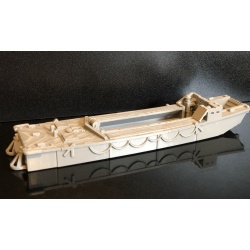
Typically constructed of hardwood planking and selectively clad with armour plate, this shallow-draft, barge-like boat with a crew of four could ferry an infantry platoon of 31, with space to spare for five additional specialist troops, to shore at 7 knots (13 km/h). Men generally entered the boat by walking over a gangplank from the boat deck of a troop transport as the LCA hung from its davits. When loaded, the LCA was lowered into the water. Soldiers exited by the boat's bow ramp.
The LCA was the most common British and Commonwealth landing craft of World War II, and the humblest vessel admitted to the books of the Royal Navy on D-Day. Prior to July 1942, these craft were referred to as "Assault Landing Craft" (ALC), but "Landing Craft; Assault" (LCA) was used thereafter to conform with the joint US-UK nomenclature system.
The Landing Craft Assault's design's sturdy hull, load capacity, low silhouette, shallow draft, little bow wave, and silenced engines were all assets that benefited the occupants. The extent of its light armour, proof against rifle bullets and shell splinters with similar ballistic power recommended the LCA. Also, many a Tommy and GI looked favourably upon the luxury of seating in the well for the soldier passengers. Throughout the war in the Atlantic, the Mediterranean, and the Indian Ocean, the LCA was the most likely sea assault transport of British Commandos, United States Army Rangers, and other special forces.