Britain had been the worldwide trend-setter in tank development from 1915, but had lost its leadership position as the Second World War approached. Hampered by restricted expenditure in the years leading up the war and still organised for operations in Imperial defence as an expeditionary force, the British Army entered the war unprepared for the very sort of combat its influential theorists such as J.F.C. Fuller and B. H. Liddell Hart had advocated. The British Army had developed two types of tanks - "Infantry Tanks" which were heavily armoured with good all terrain performance but were slow. This lack of speed was not considered a flaw as they were designed to support infantry assaults on enemy strong points or urban warfare where the ability to outpace a man on foot was deemed unnecessary. The other type were "Cruiser Tanks" which were intended for independent maneuvering, rapid breakouts and flanking attacks. Early Cruiser tanks gained performance at a cost in the armour they could carry. Reliability was an important issue especially in the harsh conditions of North Africa and the mountainous terrain of Southern Europe, where the A10 and A13 in particular were plagued by broken tracks and overheating engines.
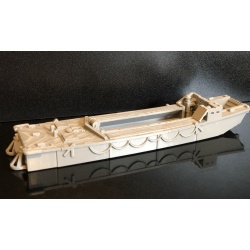
Landing Craft Assault Boat LCA
Landing Craft Assault (LCA) was a landing craft used extensively in World War II. Its primary purpose was to ferry troops from transport ships to attack enemy-held shores. The craft derived from a prototype designed by John I. Thornycroft Ltd. of Woolston, Hampshire, UK. During the war it was manufactured throughout the United Kingdom in places as various as small boatyards and furniture manufacturers.
Typically constructed of hardwood planking and selectively clad with armour plate, this shallow-draft, barge-like boat with a crew of four could ferry an infantry platoon of 31, with space to spare for five additional specialist troops, to shore at 7 knots (13 km/h). Men generally entered the boat by walking over a gangplank from the boat deck of a troop transport as the LCA hung from its davits. When loaded, the LCA was lowered into the water. Soldiers exited by the boat's bow ramp.
The LCA was the most common British and Commonwealth landing craft of World War II, and the humblest vessel admitted to the books of the Royal Navy on D-Day. Prior to July 1942, these craft were referred to as "Assault Landing Craft" (ALC), but "Landing Craft; Assault" (LCA) was used thereafter to conform with the joint US-UK nomenclature system.
The Landing Craft Assault's design's sturdy hull, load capacity, low silhouette, shallow draft, little bow wave, and silenced engines were all assets that benefited the occupants. The extent of its light armour, proof against rifle bullets and shell splinters with similar ballistic power recommended the LCA. Also, many a Tommy and GI looked favourably upon the luxury of seating in the well for the soldier passengers. Throughout the war in the Atlantic, the Mediterranean, and the Indian Ocean, the LCA was the most likely sea assault transport of British Commandos, United States Army Rangers, and other special forces.
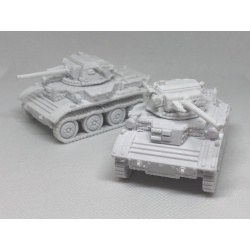
Light Tank Mk VII Tetrarch
The Light Tank Mk VII (A17), also known as the Tetrarch, was a British light tank produced by Vickers-Armstrongs in the late 1930s and deployed during the Second World War. The Tetrarch was originally designed as the latest in the line of light tanks built by the company for the British Army. It improved upon its predecessor, the Mk VIB Light Tank, by introducing the extra firepower of a 2-pounder gun. The War Office ordered 70 tanks, an order that eventually increased to 220. Production was delayed by several factors, and as a consequence, only 100 to 177 of the tanks were produced.[Note 1]
The tank's design flaws, combined with the decision by the War Office not to use light tanks in British armoured divisions, ruled out the use of Tetrarchs in the North African Campaign. As a result, the majority of the tanks remained in Britain, although 20 were sent to the USSR as part of the Lend-Lease program. In early 1941, the Royal Armoured Corps formed three squadrons for use in overseas amphibious operations, one of which was equipped with Tetrarchs. In May 1942, a small number of Tetrarchs formed part of the British force which participated in the invasion of Madagascar, and, in June 1942, Tetrarchs were attached to the 1st Airborne Division after it was decided that the design allowed its use as an air-portable light tank to support British airborne forces. The Tetrarchs were transported and landed in specially designed General Aircraft Hamilcar gliders.[4] A lack of gliders prevented their participation in the Allied invasion of Sicily in 1943; instead they were attached to the new 6th Airborne Division and became part of the 6th Airborne Armoured Reconnaissance Regiment.
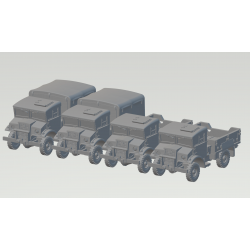
Canadian Military Pattern truck - C15 and F15 variants
Canadian Military Pattern (CMP) trucks were a class and a coherent range of military trucks, made in large numbers, and in numerous variants, by Canada during World War II, compliant to British Army specifications, primarily intended for use in the armies of the British Commonwealth allies, but also serving in other units of the British Empire.Until the currency restrictions of the late 1940s, the Canadian automotive industry's output provided a major part of British Empire countries vehicles. These territories levied reduced, Imperial preference, duties on Canadian products, usually made by Canadian subsidiaries of the big U.S. auto manufacturers. In the late 1930s, Canada started drawing up standard designs, to prepare for the beginning of the war, which involved a unique and historic design and production collaboration between rival giant car-makers Ford and GM of Canada.Canadian Military Pattern trucks not only motorized the militaries of Britain, Canada, Australia and New Zealand, but were also sent to the Soviet Union following the Nazi invasion, as part of Canada's Gift and Mutual Aid program to the Allies.During the War, CMP trucks saw service around the world in the North African Campaign, the Allied invasion of Sicily, the Italian Campaign, the Soviet Front, the Burma Campaign, the Battle of the Philippines (1941–42), the liberation of Northwest Europe, and the Western Allied invasion of Germany. CMP trucks also served in post-war conflicts in Indonesia, French Indochina, and the Portuguese colonies in Africa.
M9 A1 Half-track
The M9 half-track was a half-track produced by International Harvester in the United States during World War II for lend-lease supply to the Allies. It was designed to provide a similar vehicle to the M2 half-track car. It had the same body and chassis as the M5 half-track (also built by International Harvester for lend-lease) but had the same stowage and radio fit as the M2 half-track.
The M9 served for a significant amount of time. Three thousand five-hundred were produced by the end of World War II. It was used during World War II, the Arab-Israeli War of 1948, the Korean War, the Suez Crisis, the Vietnam War, the Six-Day War, and the Yom Kippur War. It had been used by eleven different countries by the end of its service.
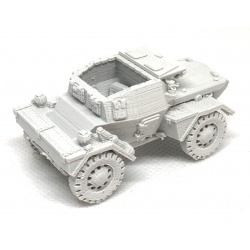
Daimler Dingo
The Dingo was first used by the British Expeditionary Force (1st Armoured Division and 4th Royal Northumberland Fusiliers) during the Battle of France. It turned out to be so successful that no replacement was sought until 1952 with the production of the Daimler Ferret. Principal users were reconnaissance units with a typical late-war recce troop consisting of two Daimler Armoured Cars and two Daimler Dingoes. The vehicle was highly sought-after with damaged Dingoes often being recovered from vehicle dumps and reconditioned for use as private runabouts. One such 'off establishment' vehicle was rebuilt from two damaged Dingoes in Normandy, 1944, by REME vehicle fitters of 86th Anti-Tank Regiment, Royal Artillery. They operated this Dingo for about a week before a higher-ranking officer spotted it and commandeered it for himself.
Writing in 1968, author R.E. Smith said that all Dingoes had now been withdrawn from British service - except for one used as a runabout at an armoured establishment - but some might have remained in Territorial Army storage at that date.[2] Many were also purchased from Canada by the Union Defence Force after the Second World War, though few South African examples have survived to the present day,[3] and were also procured in large numbers for Commonwealth patrols during the Malayan Emergency. Ten were purchased by the United States for liaison purposes during the Vietnam War, at least one turreted American prototype being tested with the 7th Cavalry Regiment.[4] In the mid-1970s, the Dingo was still being used by Cyprus, Portugal and Sri Lanka. Some may have been in reserve store with other minor nations. Surviving vehicles are now popular with historical re-enactors with reconditioned Dingoes commanding a good price.
Tank, Cruiser, Challenger (A30)
The Tank, Cruiser, Challenger (A30) was a British tank of World War II. It mounted the QF 17-pounder anti-tank gun on a chassis derived from the Cromwell tank to add anti-tank firepower to the cruiser tank units. The design compromises made in fitting the large gun onto the Cromwell chassis resulted in a tank with a powerful weapon and reduced armour. The extemporised 17-pounder Sherman Firefly conversion of the US-supplied Sherman was easier to produce and, with delays in production, only 200 Challengers were built. The Challenger was able to keep up with the fast Cromwell tank and was used with them.
M3 Stuart family
The M3 Stuart, officially Light Tank, M3, was an American light tank of World War II. It was supplied to British and other Commonwealth forces under lend-lease prior to the entry of the U.S. into the war. Thereafter, it was used by U.S. and Allied forces until the end of the war.
The British service name "Stuart" came from the American Civil War Confederate general J. E. B. Stuart and was used for both the M3 and the derivative M5 Light Tank. In U.S. use, the tanks were officially known as "Light Tank M3" and "Light Tank M5".
Stuarts were the first American-crewed tanks in World War II to engage the enemy in tank versus tank combat

Universal Carrier (Bren Gun Carrier)
The Universal Carrier, also known as the Bren Gun Carrier from the light machine gun armament, is a common name describing a family of light armoured tracked vehicles built by Vickers-Armstrongs and other companies.The first carriers – the Bren Carrier and the Scout Carrier with specific roles – entered service before the war, but a single improved design that could replace these, the Universal, was introduced in 1940.The vehicle was used widely by British Commonwealth forces during the Second World War. Universal Carriers were usually us The Universal Carrier, also known as the Bren Gun Carrier from the light machine gun armament, is a common name describing a family of light armoured tracked vehicles built by Vickers-Armstrongs and other companies.
The first carriers – the Bren Carrier and the Scout Carrier with specific roles – entered service before the war, but a single improved design that could replace these, the Universal, was introduced in 1940.
The vehicle was used widely by British Commonwealth forces during the Second World War. Universal Carriers were usually used for transporting personnel and equipment, mostly support weapons, or as machine gun platforms. With some 113,000 built by 1960 in the United Kingdom and abroad, it is the most produced armoured fighting vehicle in history.ed for transporting personnel and equipment, mostly support weapons, or as machine gun platforms. With some 113,000 built by 1960 in the United Kingdom and abroad, it is the most produced armoured fighting vehicle in history.
Austin Tilley / Austin 10
At the outbreak of the war, the British Army was still in the final stages of mechanisation. All but two of the 22 regular cavalry regiments had been mechanised (giving up horses for armoured cars or tanks) by 1940. Trucks in the 0.75- to 3-ton payload range had been brought into service during the late 1930s, being used for both transport of motorised infantry and more general transport and logistical work. However, there was still a widespread shortage of vehicles of all sizes which became more acute when the Army was mobilised for war. In particular, there was a lack of light vehicles for local liaison, communication, transport, casualty evacuation and general utility work at the smaller unit level (that of the company or battalion). While senior officers may have a staff car, junior officers and other ranks found motorised transport indispensable in an increasingly mechanised army where movements could be made of dozens of miles on graded roads.

Sexton II family self-propelled artillery
The 25pdr SP, tracked, Sexton was a self-propelled artillery vehicle of the Second World War. It was based on Canadian-built derivatives of the American M3 Lee and M4 Sherman tank chassis. Canada had setup to produce the Ram tank using the M3 chassis and Grizzly (a copy of the M4) to complement US medium tank production; when Sherman production in the US expanded and supply was no longer a problem, it was decided in 1943 to switch the Canadian production lines to produce the Sexton to give the British Army a mobile artillery gun using their 87.6 mm (3.45 in) Ordnance QF 25 pounder gun-howitzer for commonality with towed guns. The Sexton could fire either HE shell or an armour-piercing shell. It found use in the Canadian and British Army, as well as numerous other British Empire and associated forces. Just after the war, a number of Grizzly and Sextons were sold to Portugal, who used them into the 1980s.
Variants
Sexton II mid (headlights on glacis) (open & covered)
Sexton II late (headlights on front shield) (open & covered)
17 pounder, Self-Propelled, Achilles Tank Destroyer
The 17 pounder, Self-Propelled, Achilles was a British variant of the American M10 tank destroyer armed with the British Ordnance QF 17 pounder 76.2 mm (3 inch) anti-tank gun in place of the equipped 3 inch (76.2 mm) Gun M7. With a total of 1,100 M10s converted, the 17 pdr SP Achilles was the second most numerous armoured fighting vehicle to see service armed with the 17 pounder gun, behind the Sherman Firefly.
The name "Achilles" was officially a designation applied to both the 3" gun and 17 pounder versions (as Achilles I/II and Achilles Ic/IIc respectively) but was little used during the Second World War; at the time, the vehicle was called 17pdr M10, or 17pdr SP M10, or even occasionally, "Firefly". It has since become identified almost exclusively with the 17 pounder version.